
Children often need to encounter a food many times before it becomes familiar enough for them to feel comfortable eating. Research on “picky eating” suggests that offering a food again and again, without pressure to eat it, can help increase children's familiarity and acceptance of new foods. For some children this might happen after a few exposures, while others may need many more.
Importantly, an “exposure” doesn't have to mean taking a bite.
Looking at a food, touching it, smelling it, talking about it or having it nearby can all give children opportunities to become more familiar with it. This is particularly important for children who are cautious or hesitant around new foods.
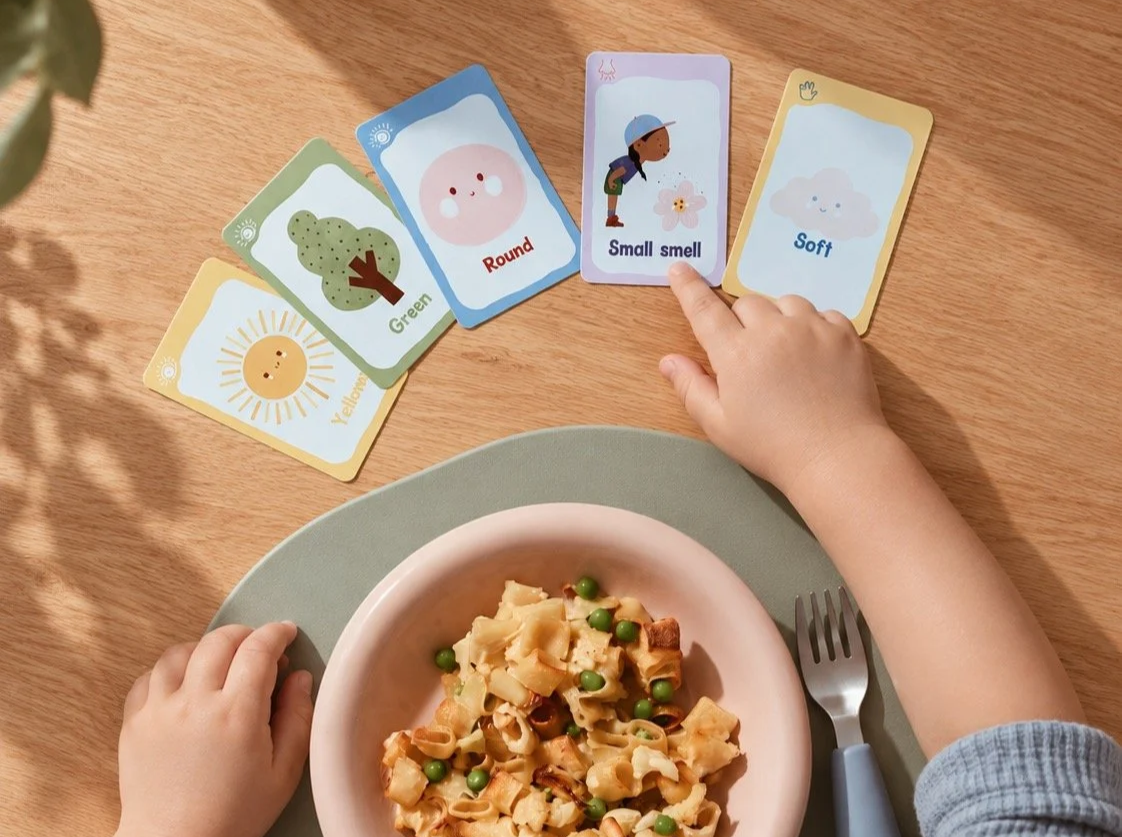
The Food Explorer Flashcards are designed to help your child build familiarity with a variety of different foods, without pressure to eat them.
Here’s how you can use them at home, in early learning settings or wherever your little foodie adventures take you.
1. Choose a food to explore
Start with a food or meal that your child is comfortable exploring or one they are curious about. There’s no need to choose a food they find particularly challenging. Food exploration is about building familiarity over time, so every food and every interaction counts.
2. Start with how it looks
Begin with the “What does it look like?” cards.
Invite your child to look at the food and choose the card (or cards) that best matches what they see.
They might notice its colour or shape. There are no right or wrong answers - your child might notice something completely different to you!
3. Explore the other senses
Once your child is ready, you can explore the other senses:
What does it feel like?
What does it smell like?
What does it sound like?
What does it taste like?
You can explore these in any order. Your child might want to skip some senses, return to one they particularly enjoy, or spend lots of time exploring just one.
You can support your child to make connections with things they are already familiar with:
“This banana is yellow, just like the sun.”
“This pasta is squiggly like the jellyfish we saw at the beach.”
“This cereal is crunchy like the autumn leaves.”
These familiar connections give children simple ways to describe and make sense of what they are experiencing.
There is no expectation to work through all five senses.
4. Let your child lead
Some children will happily touch and taste a food. Others might prefer to look from a distance or interact with it using a fork, spoon or other utensil.
They might want to smell it but not touch it. They might listen to you taking a bite or using a utensil to explore it but not explore themselves. They might decide they're finished after looking at it.
Follow their lead.
You can pause, repeat an activity or stop whenever your child wants to. Every interaction with food is an opportunity to build familiarity, and these small steps can be meaningful.
Try to stay curious alongside your child. Instead of looking for the “right” answer, wonder together:
“I wonder what this one feels like?”
“Does it make a sound when we break it?”
“What does that big smell remind you of?”
You might be surprised by just how much your child notices about a single food.
So grab your Food Explorer Flashcards, choose a food and see where your next little foodie adventure takes you.